You priced what they said. You're stuck with what they do.

A 3PL we know quoted "$2.75 per order plus shipping" to a brand expecting 8,500 orders a month. The math at signing was clean: about $108,000 in monthly revenue, the rate card said the operation was viable, contracts were signed in good faith.
Their first quarter invoice was $147,800.
That's a 37% overrun. Nobody was being dishonest. The brand's volumes ran higher than they'd projected, the pick mix changed, accessorials piled up, and by the time the operator could see the picture clearly, they were three months into a contract that was costing them money.1
This is the most common conversation we have with warehouse GMs. Not "we got the rate card wrong" — but "we have no document that compares what was promised to what actually happened." When the renewal comes around, it's a he-said-she-said. The 3PL knows the contract has been bleeding margin; the brand knows their volumes have changed; neither side has a printed page showing what was assumed at sign-off and what reality looks like. So the renewal becomes a negotiation about feelings instead of facts.
The data backs up how widespread this is.
The drift is built in
Extensiv's 4th Annual 3PL Warehouse Benchmark Report surveyed over 240 operators and found that 56% cite "uncaptured charges" as their biggest billing challenge — up from a year earlier.2
Even when charges are captured, the gap between RFP-stated volumes and 12-month-actual volumes is rarely zero. Industry survey commentary suggests actual logistics costs exceed initial quotes by 10–25%, and 65% of mid-market clients report 12–18% overruns from unquoted surcharges.3
Meanwhile, the industry's net margin has compressed from 8.83% to 7.25%.4 Wages have plateaued at elevated levels rather than declining. Contracts priced on 2021–22 cost assumptions are still bleeding — and as Capstone notes, the contract is doing the bleeding, not the operation.
CBRE put the problem cleanly in their December 2025 view on deconstructing 3PL contracts:
Deviations from the agreed plan can increase or decrease the 3PLWO's profit margin. Client costs typically vary according to volumes and activity types, which may not be accurate, particularly in early periods.5
The interesting word in there is particularly in early periods. A contract that drifts in month two doesn't get noticed until month nine. By then the renewal is a few months away and there's no record of the original assumptions to anchor the conversation.
The structural reason it happens
Three things are simultaneously true in most 3PL operations:
- The billing engine knows everything. It captures every storage pallet, every pick, every accessorial, every handling charge. Per-line-item, per-client, per-day.
- The WMS knows everything. Bin moves, pick counts, receipts, dwell times — granular operational data per client.
- Nobody on the commercial team can see (1) and (2) compared against the original quote. Because the original quote lives in an email, a PDF, or a CRM note. It was never structured data.
So when the GM walks into the renewal meeting, they have revenue numbers (the billing engine's view), operational impressions (the floor manager's view), and a vague memory of what the contract said at signing. Three views, none of which are the document that would actually settle the renewal conversation.
Takt put it this way in their analysis of margin erosion in multi-client warehouses:
Multi-client warehouses can look healthy on paper and still leak margin every day… It does not usually destroy profitability in one dramatic event. It chips away at it through small decisions the building could not see clearly enough.6
That's the structural problem. The drift isn't dramatic. It's a slow accumulation of small mismatches nobody is keeping count of.
What "keeping count" actually looks like
In our product we capture five fields at contract sign-off:
- Orders per month — the volume promise
- Picks per order — the complexity promise
- Storage profile — fast-mover, slow-mover, mixed
- SKU mix — count, range, growth assumption
- Payment terms — the cash-flow promise
Five fields. Five minutes per client. We provide the template.
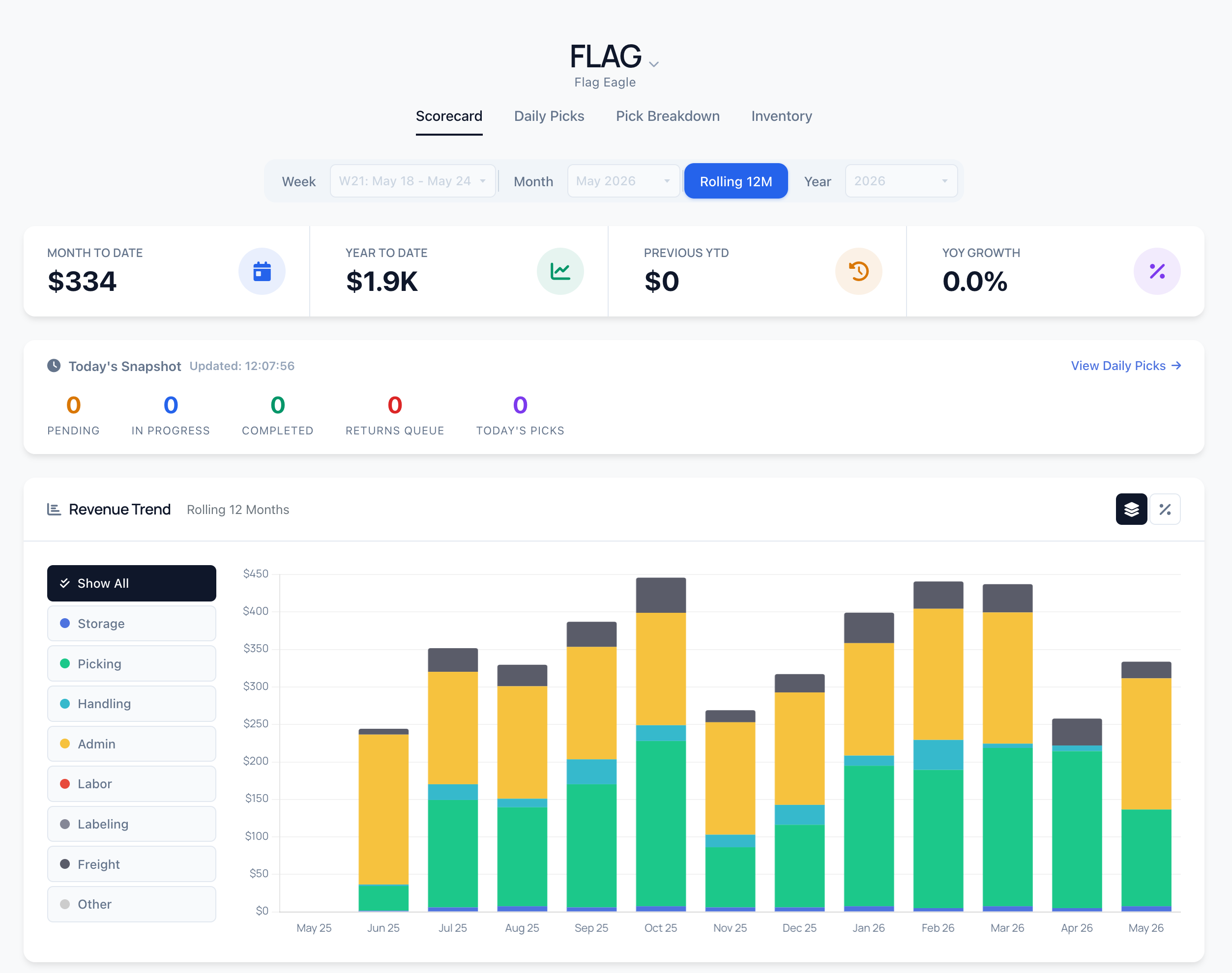
Then every month the scorecard grades the live actuals against those five fields. The activity trend tracks promised orders vs delivered orders. The storage breakdown tracks promised mix vs actual mix. The AR module tracks promised terms vs actual terms.
Amber when reality drifts 6–10% from the promise. Red when it drifts past 10%. Green when you're within tolerance.7
That's the whole document. Print it. Put it in front of the client. The conversation is no longer "I think you're sending more orders than we agreed." It's "here's the line you signed, here's where we are today, here's what the new rate should be."
Why this matters for the renewal
The contract drift problem is solved by having the document at renewal time, not by negotiating harder. The 3PLs we talk to don't lack negotiating skill. They lack evidence. And without evidence, every renewal conversation defaults to the client's framing, which is naturally going to favour the client.
When the 3PL has the page, the conversation changes. The print-out is hard to argue with. The client signed those numbers. If their actual orders are 73% higher and their pick complexity is 53% lower, that's a different deal than the one they signed, and it needs different pricing. The page makes that conversation possible.
There's also a useful by-product. The operators who run this discipline find that most clients don't object to a re-quote when they can see the math. The drift was usually invisible to them too. The conversation becomes collaborative because the data is shared, not advocated.
The wider opportunity
We don't know how big this problem is across the industry. There's no published dataset on median quote-vs-actual variance across 3PL contracts. Armstrong & Associates has the relationship data; Extensiv has the operational data; nobody has joined them. That's something we'd like to publish once we have enough customer data to anonymise. A "3PL Drift Index" would be net-new IP for the industry, and would let any operator benchmark their own contract drift against the industry median.
If you'd like to be part of that data — and walk into your next renewal with the printed page — see how it works or email us to talk about onboarding your operation.
Sources
- Lansil Global, "3PL Pricing Explained: A Complete Cost Guide," 2025.
- Extensiv, "4th Annual 3PL Warehouse Benchmark Report," 2023.
- ShipperGuide, "3PL Cost Structure," 2024.
- Capstone Partners, "3PL Market Update," January 2025.
- CBRE, "Deconstructing 3PL Contracts," December 2025.
- Takt, "Why Daily Operational Change Quietly Erodes 3PL Margins," 2025.
- ClearPoint Strategy, "Establish RAG Statuses for KPIs."